VALORANT Champions Shanghai Group Stage Day 7
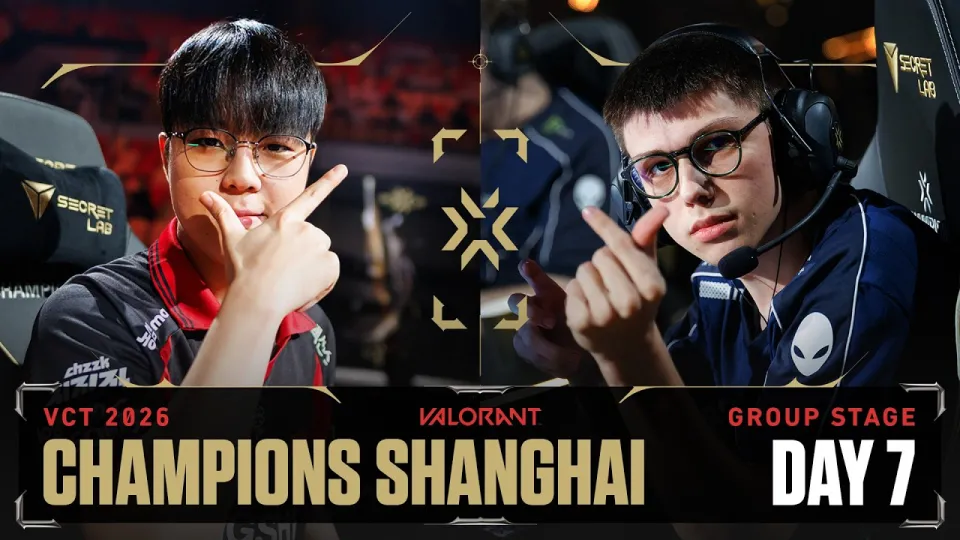
Video: VALORANT Champions Shanghai — Group Stage — Day 7
You can order the same kind of articles for your own video to boost it on YouTube and Google. Just message the Telegram bot @sat_sit_bot. Articles with your video embedded are written and posted by the bot itself — on popular topical sites (no ads). Try it free: 50 articles on us.
· based on the channel VALORANT Champions Tour
Key takeaways
- VALORANT Champions Shanghai runs September 24 to October 18, with 16 teams from Americas, CN, EMEA and Pacific.
- Day 7 of the group stage is the seventh broadcast day of the Swiss-style opening phase, streamed by the VALORANT Champions Tour channel.
- Two Masters events in 2026 produced two different champions, so Shanghai is the first true tiebreaker of the season.
- The Day 7 VOD drew attention for repeated technical pauses that split the broadcast into stop-start segments.
- Chinese representatives entered the event under heavy scrutiny after shaky eco and retake rounds in earlier group matches.
VALORANT is Riot Games' free-to-play 5v5 tactical shooter, and its biggest annual esports event is VALORANT Champions — in 2026 hosted in Shanghai, where 16 teams from Americas, CN, EMEA and Pacific fight for the world title between September 24 and October 18. Day 7 of the group stage, published by the VALORANT Champions Tour channel, closes out the opening phase that decides which teams advance to the playoff bracket and which go home. Official schedules, brackets and announcements are posted via the VALORANT Esports news and updates account.
What the VALORANT Champions Shanghai group stage format means
The Shanghai group stage is a Swiss-style phase: teams play a fixed number of matches, and results are paired by record rather than by pre-set brackets. Sixteen squads are split evenly across the four international leagues — Americas, CN, EMEA and Pacific — and each region sends four representatives. The opening phase typically runs three rounds of matches, with the first round drawn from pre-seeded pools and later rounds pairing teams on identical or near-identical records. A 3-0 start usually guarantees a playoff seed, while an 0-3 finish eliminates a team outright; the middle pack plays deciding matches on the final days.
Day 7 sits at the tail end of that phase, which is why the broadcast carries so much weight: several matches on the day are effectively elimination games, and map picks become conservative because a single loss ends the run. Because the group stage uses best-of-three series, teams can afford one map loss but not a full series defeat, so the veto phase matters as much as the aim duels.
Why Day 7 of the group stage drew so much attention
Day 7 was one of the longest broadcasts of the group stage, and a large share of that runtime came from technical pauses rather than gameplay. Viewers who watched the VOD live or in clips repeatedly flagged the number of stoppages — one of the most-liked comments under the video is a timestamp index built specifically so people could skip the dead air, and another top comment simply reads as a running joke about an endless series of tech pauses. For a tournament at this level, repeated pauses usually point to server or client issues on the stage machines, and they disrupt the rhythm of both the players and the audience.
The practical consequence for anyone catching up later is that the VOD is best watched with a timestamp guide. Skipping the pauses brings the runtime back to something close to a normal broadcast day and makes the actual VALORANT easier to follow, especially in series that went the full three maps.
The CN question: home crowd versus regional depth
The most heated discussion around Shanghai concerns the Chinese representatives. One widely liked comment argues that several teams outside CN — including squads that never qualified — would have been more competitive than the full Chinese lineup at Champions, while another dismisses CN's chances outright. The criticism is specific rather than general: lost eco rounds, failed 5v2 retakes, and utility usage that collapses once a set play breaks down.
That is a real tactical point. On the current map pool, default structures matter less than mid-round adaptation, and teams that rely on rehearsed executes get punished when opponents force chaos. Chinese squads have improved mechanically year over year, but the gap at Champions tends to show up in exactly those unstructured moments — a 5v2 that should be closed out, a save round that should be won. Whether Shanghai becomes a turning point or another learning experience depends on how those rounds are closed in the deciding matches.
Standout moments and player narratives from the broadcast
Beyond the pauses, the Day 7 VOD produced a handful of moments the community clipped immediately. One involves a Yoru clone on Split that briefly looked, at a glance, like it was helping hold a site — the kind of visual confusion that only a clone utility can create. Another is a timestamped round that got a burst of laughing reactions in the comments, a reminder that group stage days still generate highlight-reel material even when the stakes are structural rather than dramatic.
Player narratives carried the day too. A chant-style comment pushing for nats as president is the sort of shorthand fans use when a veteran controller or sentinel player puts in a series that quietly holds a team together. With two different Masters champions already crowned in 2026, the individual form of established stars versus the fearlessness of first-time Champions attendees is the through-line of the whole event.
How to watch the VALORANT Champions Shanghai VOD efficiently
Watching a seven-hour-plus broadcast day without a plan is a recipe for burnout. A workable approach:
- Open the VOD on the VALORANT Champions Tour YouTube channel and jump straight to the timestamp index in the comments, which marks the start of each map.
- Watch the veto and pistol rounds first — they set the tone for how each series is likely to go.
- Skip tech pauses entirely; they add no information and break the flow of the matches.
- For series you only care about competitively, watch the second half of each map, where adaptation and economy management decide results.
- Keep the official channels open for bracket updates, since group stage standings shift after every match day.
Where to follow results and brackets
Official standings, match schedules and bracket updates are published by VALORANT Esports across its social channels, and the event itself is streamed on Twitch and YouTube. The full list of official destinations:
- https://x.com/valorantesports — announcements, results and schedule updates
- https://www.twitch.tv/valorant — live broadcast
- https://www.youtube.com/@ValorantEsports — full VODs and highlights
- https://www.facebook.com/ValorantEsports/
- https://www.instagram.com/valorantesports/
- https://www.tiktok.com/@valorantesports
What Day 7 tells us about the Shanghai playoffs
Day 7 confirms that Shanghai is a wide-open tournament rather than a coronation. Two different Masters champions in 2026 means no single team has established dominance, and the group stage results reflect that: favorites dropped maps, underdogs closed out series, and the middle of the table stayed crowded until the final days. The teams that advance will be the ones that win the messy rounds — the ecos, the retakes, the 5v2s — not necessarily the ones with the cleanest set plays.
For CN, the home crowd is both an advantage and a magnifying glass; every lost save round gets replayed and dissected. For everyone else, Shanghai is a chance to prove that regional depth outside the big four leagues is real. The VALORANT Champions Tour channel is the place to catch the full group stage run before the bracket locks, and following the official VALORANT Esports account is the fastest way to get playoff schedules, seedings and patch notes as they drop.
Questions & answers
How many teams play at VALORANT Champions Shanghai?
Sixteen teams compete, split evenly across four leagues: Americas, CN, EMEA and Pacific. Each region sends four representatives, and the event runs from September 24 to October 18, with the group stage deciding the playoff bracket before the final rounds.
Why were there so many technical pauses on Day 7?
The broadcast was interrupted repeatedly by tech pauses, which viewers flagged in the comments and worked around with timestamp indexes. Such stoppages usually stem from server or stage-machine issues rather than player problems, and they stretch the runtime of an already long match day.
Is the group stage single or double elimination?
It is a Swiss-style phase rather than a classic bracket. Teams are paired by record across rounds, a 3-0 start effectively secures a playoff seed, and an 0-3 finish eliminates a team, with the remaining squads playing deciding matches on the final group days.
Where can I watch the full Day 7 VOD and follow the bracket?
Full VODs and highlights are on the VALORANT Champions Tour YouTube channel, with live matches on Twitch. Official results, schedules and bracket updates are posted on the VALORANT Esports X account at https://x.com/valorantesports.
Source: VALORANT Champions Shanghai — Group Stage — Day 7 · Markdown version